
If you run a business, you know the digital ecosystem has changed dramatically. The old linear “marketing funnel” no longer works, and relying solely on organic traffic or isolated search campaigns is both costly and inefficient.
Artificial Intelligence, which has eroded organic traffic through tools like AI Overviews (reducing the need for users to click on your site), is now the best ally. Google has responded to this disruption with a comprehensive approach: the AI-powered Full Funnel, which transforms marketing from a set of isolated campaigns into a system of continuous, personalized learning at scale.
This post, written in a slightly more technical style than usual but necessary to understand the full scope of Google’s new acquisition format, is designed to clarify what this strategy really means and how your company can implement it—ensuring that every dollar invested in paid advertising drives real, measurable growth.
1. What Is Google’s Full-Funnel Strategy and Why Is It Now Vital?
The traditional Awareness–Consideration–Conversion model assumed that customers followed an orderly path. Today, the customer journey is, to use a phrase that’s becoming increasingly popular, “predictably unpredictable” and highly non-linear, as people jump fluidly between searching, streaming, scrolling, and buying.
In this context, the Full-Funnel strategy recognizes this reality, aiming to influence every touchpoint across Google’s ecosystem.
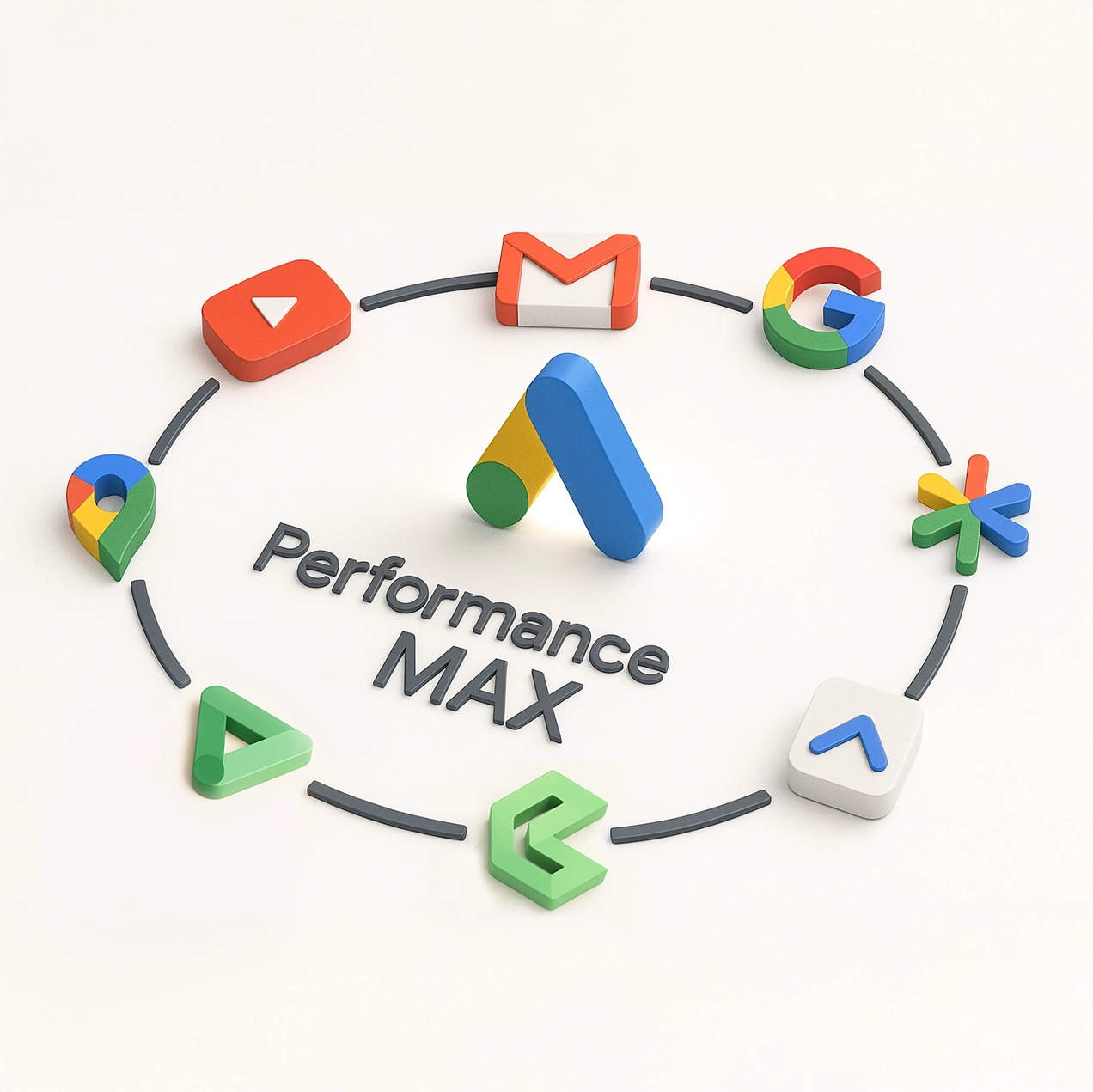
Google has consolidated this approach into what it calls the Power Pack, a suite of AI-powered solutions covering the entire funnel.

The Impact of the Mid-Funnel: Demand Gen campaigns and remarketing are crucial in this new landscape, as B2B purchase decisions rarely happen after a single search. Using Demand Gen, for example, can break through incremental sales ceilings, delivering a significantly higher Return on Ad Spend (ROAS) compared to similar social media campaigns.
2. Optimised Management: Ensuring Maximum Return for Every Dollar Spent
For any company, the key to Full-Funnel success isn’t just reach, but precision in measurement and budget allocation. Only 35% of companies manage to reallocate budgets dynamically across platforms. This is where strategic optimization stands out.
2.1. Data Accuracy and Privacy Compliance (The Foundation of AI)
In a world where cookie erosion is creating major gaps in the customer journey, Google’s AI relies on strong, privacy-compliant first-party data:
- Enhanced Conversions: Essential functionality. It allows your site to securely send primary data (like encrypted emails) to Google using SHA-256 hashing. This improves conversion measurement accuracy, cross-device attribution (when users switch from mobile to desktop), and detected conversion volume (reported lifts of 5–15%). Especially useful for long B2B cycles.
- Consent Mode v2: If you operate in the EU, implementing Consent Mode v2 is critical to preserving attribution and custom audiences, preventing Google from restricting personalization.
- CRM Integration: Generic targeting is expensive and ineffective. High-performing advertisers fully integrate CRM data with Google Ads via Customer Match, allowing budgets to be focused precisely on the right decision-makers based on sales pipeline stage or historical customer value.
2.2. Fair Attribution and Advanced Bidding Strategies
The traditional last-click attribution model is unfair, giving all the credit to the final interaction while ignoring the value of earlier awareness efforts (like video or display ads).
- Data-Driven Attribution: This model distributes conversion credit more fairly across all involved campaigns, though it only considers clicks and engaged views, not video impressions.
- Value-Based Smart Bidding: Campaigns should optimize for true business outcomes. If your leads or products have variable values, the Maximize Conversion Value bidding strategy is preferable to simply chasing clicks or conversions.
2.3. Smart Structure and Creative Intelligence
- Single-Theme Ad Groups (STAGs): Especially valuable in B2B Search Ads, this structure groups only keywords with identical search intent. This maximizes relevance between the keyword and ad copy, resulting in higher Quality Scores and lower Cost per Click (CPC).
- AI in Creativity: Leading companies are using AI tools (like Google Ads’ Asset Studio) to automatically generate multiple variations of headlines, descriptions, and visuals. This saves significant time and allows up to a sixfold increase in creative volume.
3. The Competitive Advantage of Outsourcing: Minimal Cost vs. Real Benefit
For many business owners, the question isn’t whether to invest, but how to do it. Hiring an in-house team with the expertise needed to manage the complexity of Google’s Full Funnel (PMax, Demand Gen, Enhanced Conversions, value-based bidding, CRM integrations, GA4/Consent Mode v2) requires significant labor costs and lengthy training.
This is where a specialized agency, such as a Google Premier Partner, delivers superior ROI:
- Overcoming the Human Barrier: Google notes that the biggest barrier to AI excellence isn’t the technology, but human and process adaptation. Only 10% of marketing leaders have built multifunctional AI-dedicated teams. An agency brings this expertise and structure immediately.
- Expertise in Automation and Control: Performance Max, for example, requires 2–4 weeks for its learning phase. Premature changes or incorrect setups (like conflicting audience signals or insufficient creative assets) waste budget. Experts know how to strategically guide Google’s AI for maximum effectiveness.
- Continuous Monitoring and Optimization: Success comes from rigorous weekly optimization protocols (search term reviews, bid adjustments, ad A/B testing). This disciplined approach separates best-in-class campaigns from average ones.
- Advanced Visibility: Performance Max and Demand Gen are often perceived as a “black box.” Agencies use advanced tracking methods and third-party attribution tools to overcome native reporting limits, giving deeper insights into which creatives and channels actually drive business results.
By outsourcing Full-Funnel management to experts, your company gains the benefit of the sophistication and continuous adaptation required in today’s landscape, at a significantly lower cost than maintaining a full internal team of specialists. In this way, you invest in results and strategy, not in training or staffing infrastructure.
4. The Action Plan: Leading with Precision in the Age of AI
Marketing is no longer about pushing leads down a funnel — it’s about intercepting millions of purchase signals and responding to them in real time.
To capitalize on the Full Funnel, we recommend focusing on the pillars that define AI leaders:
- AI Data Strength: Connect your first-party data (CRM) and migrate to Enhanced Conversions. Measurement accuracy is the first step to scaling.
- AI Content Strength: Feed your PMax and Demand Gen campaigns with a wide variety of creative assets (images, short-form and vertical videos) so the AI has enough “fuel” to test and identify winning combinations.
- AI Performance Strength: Use the Power Pack (PMax, Search AI Max, Demand Gen) as a synergistic system, where CRM data powers targeting and continuous optimization refines performance across campaigns.
In other words, what Google is proposing isn’t just a set of tools, but a shift in mindset. Brands that view marketing as an integrated system of continuous learning and leverage external expertise for strategic implementation won’t just survive digital disruption — they’ll set the new standards of excellence in their industries.
Are you ready to transform your results and ensure your ad spend drives sustainable growth?
We invite you to start with a free audit of your company’s current campaigns to uncover opportunities for optimizing your Full-Funnel strategy.